Role of Music as an Adjuvant Therapy in
Fournier's Gangrene
Shijina K1,
Ravi KumarChittoria2, Vinayak
Chavan1, Abhinav Aggarwal1, Saurabh Gupta1, Chirra1, Bharathi
Mohan1, Imran Pathan1, Praveen
R3
1Senior Resident , 3Junior
Resident Department of Plastic Surgery, JIPMER, Pondicherry, India.
2Professor & Registrar (Academic), Head of IT Wing and Telemedicine,
Department of Plastic Surgery&
Telemedicine, JIPMER, Pondicherry, India.
Introduction
Fournier's gangrene (FG) is an acute, rapidly
progressive, and potentially fatal, infective necrotizing fasciitis affecting
the external genitalia, perineal or a perianal region, which commonly affects
men, but can also occur in women and children.[1] Prompt surgical debridement
and use of suitable broad-spectrum antibiotics is the corner stone for
treatment of Fournier's gangrene. If early intervention is not done, Fournier's
gangrene may lead to high mortality (20-30%).[2] Music therapy has been attempted
as one of the adjuvant therapy in medicine, but on internet (google) we didn't
find any study utilizing music therapy in Fournier's gangrene. This study
highlights of role of music therapy as an adjuvant therapy in the management of
Fournier's gangrene. Aim: This is a preliminary study to find the role of music therapy as
an adjunct treatment in the management of Fournier's gangrene.
Material and Methods
This single case study was conducted in the Department
of Plastic Surgery in a tertiary care hospital in during February to March
2019. An informed written consent was taken from the subject under study who
was a 65 year old gentleman, a known case of long standing diabetes
mellitus with hyperthyroidism presented with an ulcer over scrotum following
surgery for hydrocele (figure 1). On admission, patient was febrile, toxic with
throbbing pain. Broad spectrum antibiotics according to culture and sensitivity
was started. Strict glycaemic control was achieved. For reconstruction, wound
bed preparation was done with multiple surgical debridement, low level laser
therapy (LLLT), Autologous Platelet Rich Plasma (APRP) therapy, and topical
insulin, phenytoin & Cholecalciferol (vitamin D) with tobramycin
application and temporary cover with heterografting (collagen based biological
dressing). In addition, an adjuvant therapy was given. Patient was made to
listen to Indian Classical Raagas such as Raag Jaijaiwanti and Raag Bageshri
during dressings & additionally 10 minutes daily for 3 times a day during
period (3 weeks) of wound bed preparation (WBP) (figure 2). Feedback was taken
from patient about how he feels during listening of music, whether it helps him
in alleviating his anxiety, stress, pain relief during dressing indirectly
helping in wound healing & recovery; and would he recommend music therapy
for other patients or not.
Results
Wound Bed Preparation (WBP) including music therapy
was given for a period of (3 weeks) till wound bed was made ready. Once wound
bed got ready (figure 3), reconstruction was done with local advancement flap
with primary closure (figure 4). Patient was discharged with complete wound
healing. On follow-up, patient is normal with his daily routine activities.
|
|
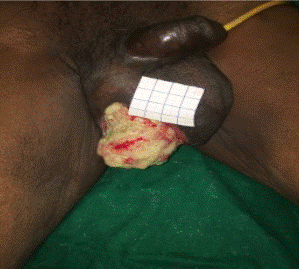
Figure 1. Fournier's gangrene with ulcer
over scrotum.
|
|
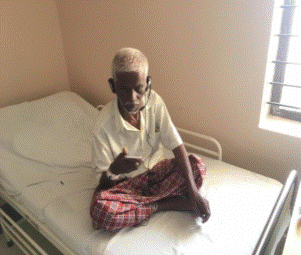
Figure 2. Patient undergoing music therapy
session.
|
|
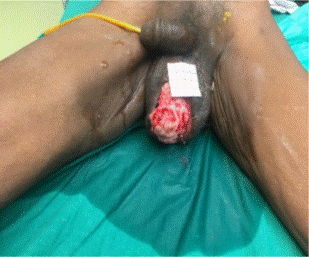
Figure 4. After 3 weeks of Wound Bed
Preparation (WBP) including music therapy.
|
|
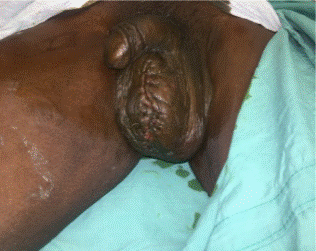
Figure 5. Complete wound healing after
reconstruction.
Discussion
There are various adjuvant therapies which are being
practiced in medicine like hypnosis has been studied for pain control in burn
patients and concludes that hypnosis supplemented by little or no opioid
medication results in excellent pain control, absence of need for supplemental
anxiolytic medication, and shortens period of wound care. This is achieved by
activation of non-opioid inhibitory mechanisms by hypnosis in a highly
effective manner.[3] Many authors have reported that analgesic therapy alone is
inadequate for pain relief and distraction therapy may help.[4] Further, some
of the author have compared the use of video recordings (scenic beauty)
accompanied by music to analgesia alone during burn dressing and found reduced
pain and anxiety and recommended to use with analgesics to augment its effect
during burn dressing.[5] Music therapy is an upcoming alternate
adjuvant therapy for management of wounds & burns in spite of the fact that
its effects and mechanism remains not clear. Particularly in the form of
adjuvant therapy as part alternative medicine, music therapy has been widely
used in multiple clinical fields due to its non-pharmacological, non-invasive
and easily accessible features. Surgical residents generally ignore the use and
efficacy of non-pharmacological adjuncts in the management of wounds.
Literature search yields various articles on non-pharmacological adjunct
treatment of pain and burns. These do suggest a cryptic role of the adjunct
therapy like music therapy in wound healing related to unknown neural pathways.
Further there are other mechanisms like enhancement of mood in pathogenesis and
regulation of glycaemic control and its effect over wound healing. The
understanding of music's role in medicine is undergoing a rapid transformation
based on neuro-scientific research showing the reciprocal relationship between
neurobiological foundations of music in the brain and behaviour.[6] The
empirical studies on therapeutic evaluation of the Indian classical raagas have
shown interesting results. Raag Bhairavi has been found to uproot certain
diseases like asthma, chronic cold, cough, tuberculosis, some of the sinuses
and chest related problems. Raag Malhar pacifies anger, excessive mental
excitements and mental instability. Raag Surat and Raga Jaijaivanti have also
been found effective in curing mental disorders and calming the mind.[7] Apart
from this, music therapy helps in better inter-personal communication between
patient and medical staffs. As a pilot preliminary work, the
authors of this study have designed and carried out this study to find role of
music therapy in the management of Fournier's Gangrene, a necrotising fasciitis
involving the perineum that does not commonly herald a good prognosis most of
the times. Based on feedback from patient and positive outcome authors feel
there is a positive association between music therapy and Fournier's Gangrene
and application of music therapy can be extended to other wounds and infective
pathologies. There are limitations in the present study as it's a single centre
study, performed on one subject with no control, comparison, randomization and
statistical analysis. A large multicentre, double blind, control study with
statistical analysis is recommended to substantiate the role of music therapy
in Fournier's gangrene.
Conclusion
Present study of using music therapy as an adjuvant
showed a positive effect in the management of Fournier's gangrene. Listening to
music helped him in alleviating his anxiety, stress, pain relief during
dressing which indirectly helped in wound healing and recovery.
Limitations of study: It is a single case study, so further requires a large
multicentre, double blind, control study with statistical analysis to
substantiate the result of this study.
References
- Smith GL, Bunker CB, and Dinneen M D .
Fournier's gangrene. British Journal of Urology 1998;81(3):347. [Google Scholar]
- Mallikarjuna MN, Vijayakumar A, Patil VS,
Shivswamy BS. Fournier's gangrene: current practices. ISRN surgery. 2012
Dec 3; 2012. [Google Scholar]
- Ohrbach R, Patterson DR, Carrougher G, Gibran
N. Hypnosis after an adverse response in an ICU burn patient. Clin J Pain
1998;14:167. [Google Scholar]
- Miller AC, Hickman LC, Lemasters GK. A
distraction technique for control of burn pain. J Burn Care Rehabil
1992;13:576-80. [Google Scholar]
- Marvin JA, Muller MJ, Blakeney PE, Iii
MWJ. Pain response and pain control. In: Herndon DN, editor. Total burn
care. Philadelphia: WB Saunders; 1996. [Google Scholar]
- Fratianne RB, Prensner JD, Huston MJ,
Super DM, Yowler CJ, Standley JM. The Effect of Music-Based Imagery and
Musical Alternate Engagement on the Burn Debridement Process. J Burn Care
Rehabil 2001;22(1):47. [Google Scholar]
- Madhuri S, Rajnee K, Chandra M. The
effects of musical therapy on clinical and biochemical parameters of
metabolic syndrome. J Bangladesh Soc Physiol 2011;6(2):108-115. [Google Scholar]
Correspondence: Dr.Kumar Chittoria, Professor & Registrar (Academic), Head of IT Wing and Telemedicine,
Department of Plastic Surgery& Telemedicine, JIPMER, Pondicherry, India. Email: drchittoria@yahoo.com